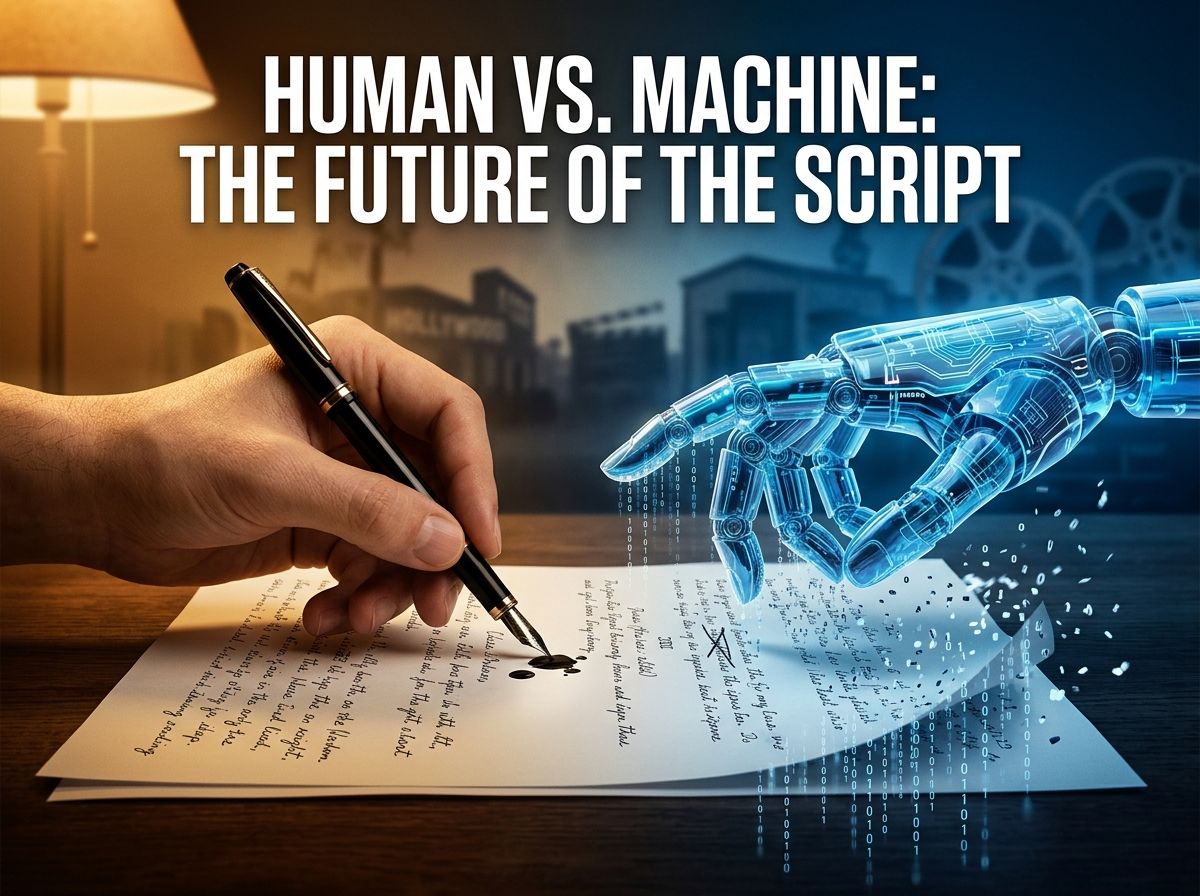
Health fund insolvency, an exhausted staff, and the $6.5B memory of 2023 drove both sides to agree a month early. The urgency of the AI training compensation clause has a ground-level explanation: assistants have long been processing writers' scripts through unauthorized AI tools — and no one told them to stop.
The Writers Guild of America reached a tentative four-year agreement with the Alliance of Motion Picture and Television Producers on April 5, 2026 — nearly a month before its May 1 contract expiration. The deal centers on a four-year contract term, a multi-million dollar infusion into the guild's health plan, strengthened AI training data compensation provisions, increased streaming residuals, and pension improvements.
Three structural forces made an early settlement not just possible but necessary: the health fund was on track to exhaust its reserves within three years; a seven-week-plus staff strike at WGA West had made it physically impossible for the guild to organize a work stoppage; and the memory of the industry's 148-day, $6.5 billion ordeal in 2023 had left neither side with any appetite for a repeat.
To understand why the AI compensation clause was among the hardest-fought provisions in the deal, it helps to look at what has been happening on the studio floor — because Hollywood's assistants were already using AI to read scripts, and no one was watching.
[ Deal at a Glance ]
Contract Term | 4 years (standard 3; AMPTP sought 5, WGA resisted — 4 is the settlement) |
Health Plan | Multi-million dollar infusion ($37M added costs in 2025; fund near depletion in 3 years) |
AI Protections | 2023 provisions expanded — stronger legal basis for writer compensation on AI training use |
Streaming | Higher fees for streaming-only productions + increased SVOD residuals |
Pension & Jobs | Pension increases + expanded employment guarantees in development rooms |
Tone | Collaborative — new AMPTP head Greg Hessinger declared a deliberate 'relationship reset' |
Ratification | WGA board approval, then member vote required (details released post-ratification) |
■ A Deal Without a Strike: Three Structural Forces
The 2023 strike left marks that have not faded. The combined WGA and SAG-AFTRA walkout cost the film and television industry an estimated $6.5 billion and lasted 148 days. Going into 2026 negotiations, both sides were operating under an unspoken but widely understood premise: another strike was not an option. The health fund was the most concrete pressure: $37 million in additional costs were absorbed in 2025 alone, and at current trends the fund would run dry within three years. The AMPTP was prepared to supply a significant cash infusion; in exchange, it pushed for five years. The final agreement landed at four.
The WGA West staff strike added an operational constraint that made a work stoppage nearly impossible regardless of intent. With staff on the picket line for more than seven weeks, the guild could not organize and run a full-scale strike. In a break from recent practice, the WGA did not even seek a strike authorization vote from its membership. As one industry source summarized: this ain't 2023.
■ 'A Relationship Reset': New Leadership, Different Room
AMPTP, now led by Greg Hessinger following the long tenure of Carol Lombardini, telegraphed its intentions before talks began. 'We want a reset in the relationship, and we're going to do our part,' a labor insider told Deadline. WGA Executive Director and chief negotiator Ellen Stutzman — who had taken over mid-strike in 2023 and helped deliver that settlement — led the negotiations again alongside committee co-chairs John August and Danielle Sanchez-Witzel. With 97% of WGA membership supporting the bargaining approach, talks began in mid-March 2026 and concluded in roughly three weeks.
■ The AI Clause: From 'Guardrails' to 'Compensation Rights'
The 2023 WGA contract established the first contractual framework for AI: companies cannot require
📎 Read full article on K-EnterTech Hub →
About K-EnterTech Forum · K-엔터테크포럼
K-EnterTech Forum (K-ETF, K-엔터테크포럼)은 엔터테인먼트 테크놀로지, K-콘텐츠, 한류, 미디어 정책 분야의 전문 인사이트를 제공하는 국내 대표 플랫폼입니다. K-팝·K-드라마·K-푸드·K-컬처와 AI·스트리밍·크리에이터 이코노미·방송 기술의 공진화(Co-Evolution) 전략을 연구하고, 국내외 포럼·행사를 통해 정책 및 산업 협력 의제를 이끌고 있습니다.
K-EnterTech Forum is Korea's leading platform for insights on entertainment technology, K-Content, Hallyu, and media policy — bridging Korean cultural industries with global technology trends.
고삼석 상임의장 · Chairman Samseog Ko
고삼석(Ko Samseog)은 K-EnterTech Forum 상임의장입니다. 동국대학교 첨단융합대학 석좌교수이자 국가인공지능전략위원회 분과위원으로, 30년 이상의 방송통신 정책 및 산업 경험을 바탕으로 K-콘텐츠와 글로벌 엔터테인먼트 기술의 융합을 선도하고 있습니다. 前 방송통신위원회 상임위원을 역임했으며, ZDNet Korea에 정기 칼럼을 연재 중입니다.
Samseog Ko is the founding Chairman (상임의장) of K-EnterTech Forum. He is a Distinguished Professor at Dongguk University and a member of Korea's National AI Strategy Committee. Former Commissioner of the Korea Communications Commission (KCC).
📩 familygang@naver.com | 🌐 entertechfrum.com | 고삼석 상임의장 소개 →


