Otis College Report: AI Is Rewriting the Grammar of Creative Work — Not Eliminating the Workers Who Do It
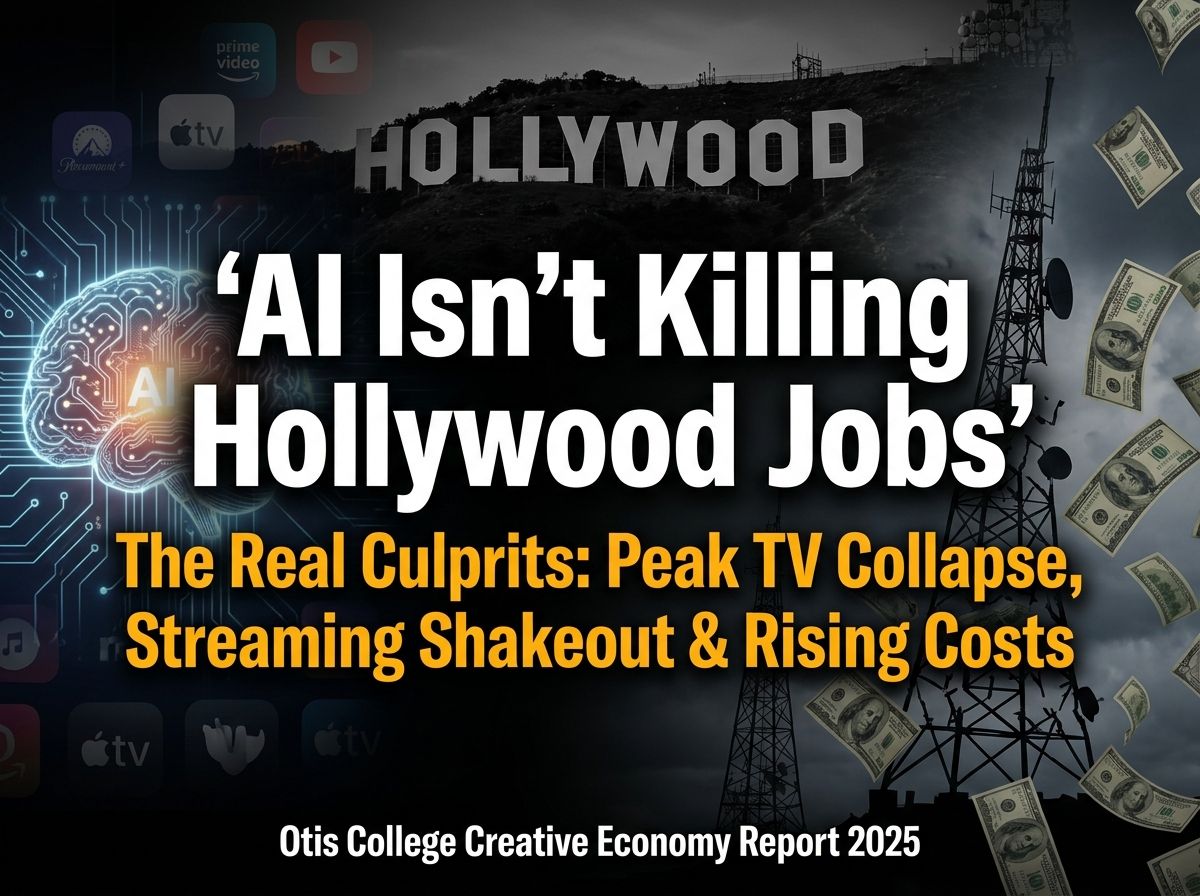
When generative AI emerged onto the scene, California's creative economy began shedding jobs at an alarming rate — 114,000 positions, or 14 percent of the workforce, vanished between 2022 and 2025. The world quickly settled on a narrative: AI was replacing creative workers. A new report from Los Angeles-based Otis College of Art and Design, released April 7, demolishes that narrative with data. The occupations most exposed to AI — writers, software developers, artists — actually grew during this period. The sectors that contracted most were film, television, and traditional media, gutted not by algorithms but by the collapse of Peak TV and the pivot to streaming profitability. The verdict: the real culprits are structural cost pressures and industry restructuring — not artificial intelligence. |
What the Numbers Actually Show
California's creative economy lost 114,000 jobs between 2022 and 2025 — a 14 percent decline. The film, TV, and sound sector contracted by nearly 30 percent; traditional media fell by approximately 34 percent. On the surface, these losses coincide with the ChatGPT release in November 2022. But the report's authors argue the pattern of losses does not match an AI displacement scenario.
Co-author Patrick Adler, founding partner of Westwood Economics and Planning Consultants, is direct: "The pattern of job loss in terms of the types of jobs that are being lost and when they're being lost does not support the fact that there's been this displacement of workers by AI." The losses instead reflect the unwinding of Peak TV, streaming platforms' hard pivot to profitability, and the migration of lower-wage roles out of California due to soaring living costs. Meanwhile, new media employment surged 47 percent, and streaming held near the national average.
[Figure 1] California Creative Economy Employment Change by Sector (indexed, 2017 Q1 = 0). Source: Otis College / BLS QCEW
The Counterintuitive Finding: AI-Exposed Jobs Are Growing
The report's most striking finding is that the occupations most exposed to AI tools are actually adding jobs. Writers, software developers, and visual artists — the roles most frequently cited as vulnerable to generative AI — saw increases in both employment and job postings between 2022 and 2025.
This suggests that, at least at this stage of AI's development, a complementarity effect is outweighing displacement. AI tools appear to be amplifying demand for high-skill creative workers who can leverage them, rather than replacing those workers outright. The caveat: this is a snapshot, and the authors acknowledge the calculus could shift as AI capabilities mature.
[Figure 2] AI-Exposed Occupations Grow While CA Creative Economy Contracts (Index 2022=100). Source: Otis College / CPS·BLS
How AI Is Actually Used on Set and in Studios — Task-Level, Not Role-Level Replacement
The qualitative interviews paint a consistent picture. Not a single respondent described AI as having replaced their entire role or workflow. Instead, AI is being deployed for specific, bounded tasks — "where the output is verifiable, time savings are clear, and the quality of output meets expectations" (AI is replacing specific tasks instead of staffers).
In post-production, AI substantially reduces repetitive work like rotoscoping and wire removal, but human review and correction remain necessary — limiting the net cost savings. Auto-generated masks and cleanup results frequently contain errors on hair, translucent objects, and complex backgrounds, requiring senior and mid-level artists to review and correct frame by frame.
This creates a "QC workforce" that can offset, and in some feature or series contexts exceed, the cost savings from reduced rendering and outsourcing. One VFX company owner put it plainly: "They have 15 artists that are sitting at workstations fixing the AI. When you multiply the rate of the artists by 15 and put that against the cost of the work you're doing, it negates any savings that AI is giving you."
A subtler finding: some workers are hiding their AI use, fearing it marks them as replaceable. One motion creative director captured the deeper cultural risk: "The creative director said, 'At a certain point, you just have to say i
📎 Read full article on K-EnterTech Hub →
About K-EnterTech Forum · K-엔터테크포럼
K-EnterTech Forum (K-ETF, K-엔터테크포럼)은 엔터테인먼트 테크놀로지, K-콘텐츠, 한류, 미디어 정책 분야의 전문 인사이트를 제공하는 국내 대표 플랫폼입니다. K-팝·K-드라마·K-푸드·K-컬처와 AI·스트리밍·크리에이터 이코노미·방송 기술의 공진화(Co-Evolution) 전략을 연구하고, 국내외 포럼·행사를 통해 정책 및 산업 협력 의제를 이끌고 있습니다.
K-EnterTech Forum is Korea's leading platform for insights on entertainment technology, K-Content, Hallyu, and media policy — bridging Korean cultural industries with global technology trends.
고삼석 상임의장 · Chairman Samseog Ko
고삼석(Ko Samseog)은 K-EnterTech Forum 상임의장입니다. 동국대학교 첨단융합대학 석좌교수이자 국가인공지능전략위원회 분과위원으로, 30년 이상의 방송통신 정책 및 산업 경험을 바탕으로 K-콘텐츠와 글로벌 엔터테인먼트 기술의 융합을 선도하고 있습니다. 前 방송통신위원회 상임위원을 역임했으며, ZDNet Korea에 정기 칼럼을 연재 중입니다.
Samseog Ko is the founding Chairman (상임의장) of K-EnterTech Forum. He is a Distinguished Professor at Dongguk University and a member of Korea's National AI Strategy Committee. Former Commissioner of the Korea Communications Commission (KCC).
📩 familygang@naver.com | 🌐 entertechfrum.com | 고삼석 상임의장 소개 →


